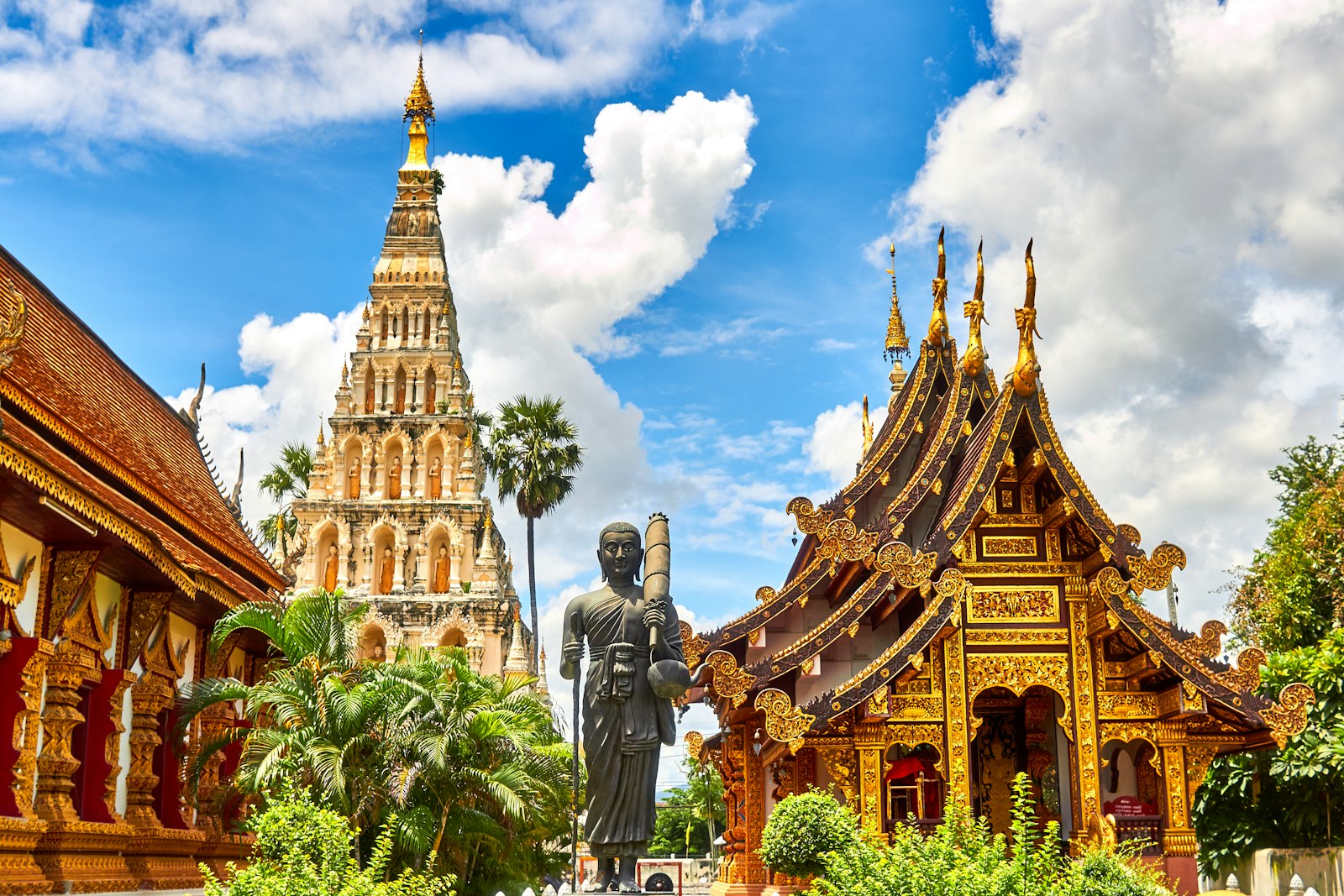
Thailand Travel Guide 2026
Bangkok, the north, and the islands — Southeast Asia’s most independent-traveler-friendly country.
Search flightsWhy Thailand in 2026
Thailand remains Southeast Asia’s most tourism-ready country — the infrastructure for independent travel (trains, buses, budget flights, English-friendly hospitality) is more developed than almost anywhere else in the region, while daily costs stay remarkably low: $25–50 covers a comfortable budget-to-mid-range day including food, transport, and accommodation.
What makes it compelling beyond the price: genuine variety in one country — Bangkok’s chaos and street food, northern Thailand’s mountains and temples (Chiang Mai), and the southern islands’ beaches (Phuket, Koh Samui, Koh Phangan) — without needing a second visa or flight to a different country.
What to know before you go
Bangkok is a stopover, not the whole trip
Most travelers spend 2–4 days in Bangkok, then head north to Chiang Mai or south to the islands. Trying to ‘do Thailand’ from Bangkok alone misses most of what makes it worth visiting.
What a Day in Thailand Actually Costs
Real per-day cost ranges based on our destination research, broken down by travel style. Your total will vary, but this gives you a realistic starting budget.
| Per day | Budget | Mid-range | Comfort |
|---|---|---|---|
| Accommodation | $10 | $30 | $80 |
| Food | $8 | $15 | $35 |
| Local transport | $3 | $8 | $20 |
| Activities | $5 | $15 | $40 |
| Total / day | $26 | $68 | $175 |
Domestic flights are cheap and worth using
Bangkok to Chiang Mai or Phuket runs $30–60 on budget carriers (AirAsia, Thai Lion Air) and saves 10+ hours versus overland travel.
Street food is not just safe, it’s often the best food
Stick to stalls with high turnover and long local queues. A full meal typically costs $1.50–4.
Visa-free for most nationalities
Many nationalities (including EU, US, UK, Australia) get 30-60 days visa-free on arrival as of current policy — verify your specific country’s allowance before flying, as rules do change.
The islands split into two very different scenes
Full Moon Party islands (Koh Phangan) are loud and young; Koh Samui and Koh Lanta are calmer and more family/couple-friendly. Pick based on what you actually want.
Best time to visit
November–February is peak season for a reason: dry, warm (not scorching), and comfortable across the whole country. March–May gets very hot, especially in Bangkok and the north. June–October is the rainy season — but rain usually means short, heavy downpours rather than all-day washouts, and hotel prices drop significantly, making it a reasonable budget window if you don’t mind some wet days.
Getting there
Bangkok’s two airports (BKK Suvarnabhumi for full-service carriers, DMK Don Mueang for budget airlines) connect to nearly every major hub in Asia, the Middle East, Europe, and Australia. Phuket (HKT) and Chiang Mai (CNX) also have direct international connections from several Asian cities.
Getting around
Bangkok: BTS Skytrain and MRT subway are cheap, clean, and avoid the city’s notorious traffic — use them over taxis whenever possible. Domestic flights: The fastest way between regions; AirAsia and Nok Air cover most routes. Overnight trains: Bangkok to Chiang Mai is a scenic, cheap ($15–40) overnight option if you’re not in a rush. Songthaews/tuk-tuks: Short local hops; always agree the price before getting in.
Where to stay
Budget ($8–18/night): Hostels in Bangkok’s Sukhumvit or Chiang Mai’s Old City. Mid-range ($25–55/night): Boutique guesthouses or 3-star hotels with pools. Splurge ($80–180/night): Beachfront resorts in Phuket or Koh Samui that would cost 3–5x as much in comparable Caribbean or Mediterranean destinations.
eSIM & connectivity
Thailand has excellent, fast 4G/5G coverage even outside major cities. A Thailand or Southeast Asia eSIM is the easiest option — instant activation, no need to find a store. Local SIMs (AIS, DTAC, True) are also cheap and widely available at 7-Elevens.
Travel insurance for Thailand
Standard policies cover Thailand well. If you’re planning to ride a scooter (extremely common but a major source of travel insurance claims — and denials, if you lack the right license class), diving, or Muay Thai training, check your policy explicitly covers those activities. Compare travel insurance here.
Go Deeper
What to Pack for Thailand
The non-obvious stuff people forget, plus what genuinely helps.
Don’t forget
- Lightweight, breathable clothing — humidity is constant year-round
- Modest clothing (covered shoulders/knees) for temple visits
- A dry bag or waterproof phone pouch for islands/boats
- Universal power adapter (Type A/C/O sockets)
Nice to have
- Mosquito repellent, especially outside Bangkok
- Reef-safe sunscreen for island destinations
- Sandals that survive both beach and street use
- A portable fan or cooling towel for peak heat months
Not Sure When to Go?
Check Flight Prices
Practical Info: Culture, Currency & Electricity
Top Attractions
- Grand Palace and Wat Phra Kaew, Bangkok
- Wat Arun and a Chao Phraya river cruise
- Chiang Mai’s old city temples
- Railay Beach, Krabi
- Floating markets
Culture & Etiquette
The monarchy is treated with deep reverence — criticism of the royal family is both a serious social taboo and a legal offense, worth being aware of. The head is considered the most sacred part of the body and the feet the least, so avoid touching people’s heads and don’t point your feet at people or Buddha images. A wai (palms together, slight bow) is the traditional greeting.
Currency & Exchanging Money
Currency: Thai Baht (THB)
Thailand is famous for ‘SuperRich’ branded exchange chains (green and orange, both legitimate but separate companies) offering rates that consistently beat banks — widely available in Bangkok’s malls and tourist areas. Bank ATMs charge a flat foreign-transaction fee per withdrawal (a few hundred baht), so withdrawing larger amounts less often saves money versus many small withdrawals.
Been here? Rate your currency-exchange experience below to help other travelers.
Electricity & Adapters
Voltage: 220V, 50Hz
Plug type: A, B, and C (mixed — bring a universal adapter)
If your home plug type doesn’t match, bring a universal travel adapter — it’s the one item worth packing regardless of destination.
How Does It Compare?
Everything else for your trip
Flights
Compare fares across airlines. Find the cheapest day, route, and fare class for your trip.
Search flightsHotels
One search across every major booking site. Same room, different prices — pick the lowest.
Compare hotelsCar Rental
Compare rental companies at your destination before you land. No counter surprises.
Find a rentalTaxis & Transfers
Pre-book an airport transfer. Fixed price, driver waiting, no haggling on arrival.
Book a transferTravel Insurance
Compare policies and coverage before you need one. Medical, cancellation, adventure.
Compare policieseSIM
Get mobile data the moment you land. No SIM counter, no roaming charges.
Get an eSIM